
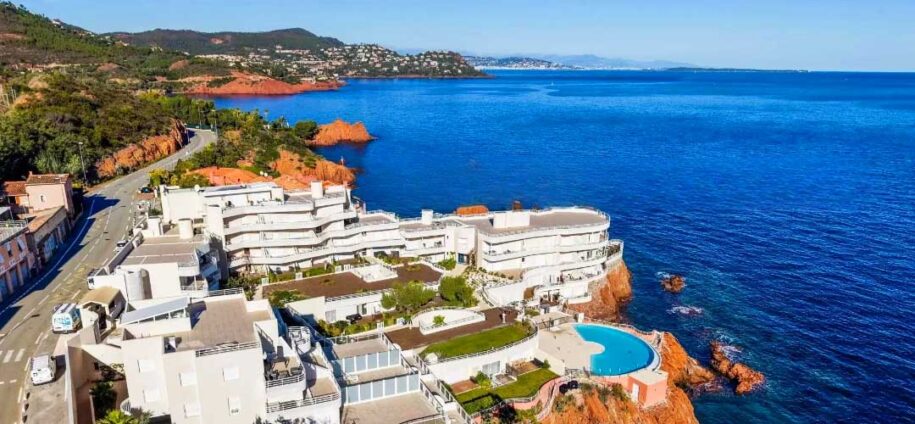
With its spectacular panoramas where the vibrant red of volcanic rocks plunges into the azure blue of the Mediterranean, the Corniche de l’Estérel is a jewel of the French coastline. But behind this legendary thirty-kilometer road, which connects Théoule-sur-Mer to Saint-Raphaël, lies a monumental undertaking. Inaugurated in 1903, this route required five years of relentless struggle against a hostile terrain to establish itself as a timeless symbol of French travel.
For anyone traveling it today, the Corniche d’Or evokes freedom, holidays, and the good life. Yet, for centuries, crossing the Esterel Massif was a veritable expedition, even an ordeal. Far removed from the poetry of modern road trips, travelers had to contend with the Via Aurelia, an ancient road dating back to the 3rd century BC. While this historic route connected Rome to Spain, it proved completely unsuitable for the development of 19th-century transportation and the nascent tourism industry on the French Riviera.
A visionary’s audacious gamble
In the late 1800s, the French Riviera began attracting its first wealthy visitors, but the Esterel Massif remained a wild and difficult-to-access territory. One man would change the destiny of this coast: Abel Ballif. Then president of the prestigious Touring Club de France—a key association in the development of tourist infrastructure and signage in France—he recognized the extraordinary potential of these unspoiled landscapes. His ambition? To tame the rock and offer the first motorists an unparalleled panoramic road.
The challenge is immense. The construction project, launched at the end of the 19th century, will last for five long years. Facing the workers is an untamed nature: steep cliffs, rugged ravines and extremely hard volcanic rock.
Five years of facing the rock
To build the road, the mountain had to be blasted through by hand and with explosives, threatening rock faces had to be secured, and daring crossings over coves had to be devised. “It took five years to overcome this technical challenge, and a very significant investment: it was necessary to coordinate stakeholders and provide access to difficult crossings…,” recalls Dorothée Tassan, deputy director of the Estérel Côte d’Azur tourism promotion agency.
In 1903, the effort finally paid off. The road was inaugurated, opening up the region to the local population. While the railway had already allowed travel through the area since 1863, the Corniche de l’Estérel offered a completely different experience: one of contemplative slowness. Very quickly, the striking contrasts between the red of the rock, the green of the Mediterranean vegetation, and the azure blue of the sea captivated visitors. Post-Impressionist painters, such as Louis Valtat and Maurice Eliot, set up their easels there, immortalizing this unique light.
A myth that transcends the ages
More than a century later, the magic remains intact. Having celebrated its 120th anniversary in 2023 with a large gathering of classic cars, the Corniche d’Or still holds a special place in the hearts of the French and vintage car enthusiasts.
It’s no coincidence that it’s often called the “French Route 66.” Like its American counterpart, it embodies a certain idea of adventure, rooted in a rich tourism history and exceptionally vibrant local heritage. A legendary road ripe for rediscovery, to the rhythm of a purring engine and the gentle lapping of the waves.
![🏖️]() Ready for an unforgettable holiday on the French Riviera?
Ready for an unforgettable holiday on the French Riviera?
 Ready for an unforgettable holiday on the French Riviera?
After a busy day spent strolling along the Croisette, browsing the markets, or paddling along the red cliffs, escape the crowds. Find absolute serenity at Cap Nérée 225. Admire the sunset from your private terrace or enjoy a peaceful swim in the infinity pool suspended above the waves.


